
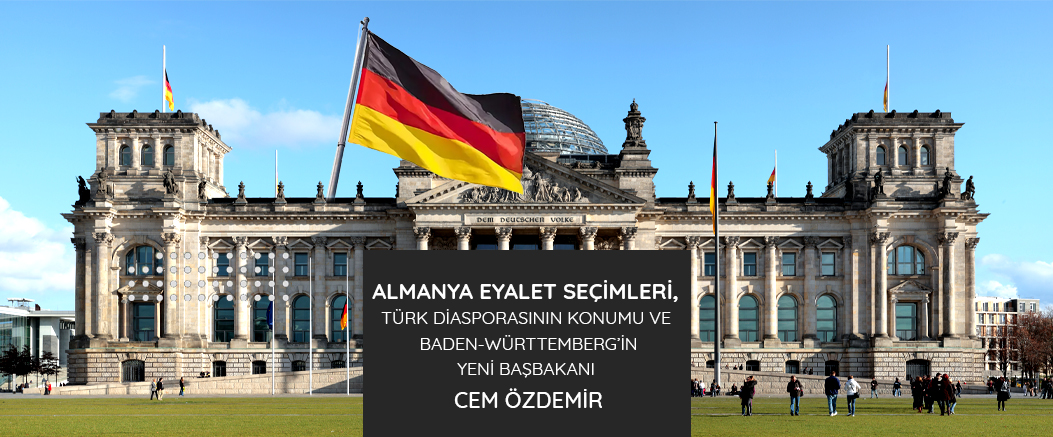
Baden-Württemberg (8 March) & Rhineland-Palatinate (22 March)
A Minister-President of Turkish origin & the rise of the far right
In 2026, state elections are scheduled in Germany in Baden-Württemberg (8 March), Rhineland-Palatinate (22 March), Saxony-Anhalt (6 September), Berlin (20 September), and Mecklenburg-Vorpommern (20 September).
Indicator | Baden-Württemberg | Rhineland-Palatinate |
Election date | 8 March 2026 | 22 March 2026 |
First party | Greens (lead candidate Özdemir) Liberal Left, (30.2%) | CDU (lead candidate Schnieder) Centre-Right, (31.0%) |
Second party | CDU (Christian Democrats), | SPD (Social Democrats), |
Third party | AfD (Alternative for Germany) | AfD (Alternative for Germany), |
Turnout | 69.6% | 68.5% |
Size of parliament | 157 seats | 105 seats |
Main parties below threshold | FDP (Free Democrats) (4.4%), Left Party (4.4%) | FDP (Free Democrats) (2.1%), Free Voters (4.2%), Left Party (4.4%) |
Coalition government | Greens + CDU = 112 seats | CDU + SPD = 71 seats |
Baden-Württemberg: The Greens’ Victory and the Cem Özdemir Factor
In the election held on 8 March 2026, the Greens (environmentalist left) came first with 30.2%, while the Christian Democratic Union (CDU, centre-right) followed very closely in second place with 29.7%. Alternative for Germany (AfD, far right) came third with 18.8%, while the Social Democratic Party (SPD, centre-left) only managed to clear the parliamentary threshold with 5.5%. The rise in voter turnout to 69.6% shows that the electorate continues to display strong interest in political competition at the regional level.
This result shows that, in an economically strong and historically conservative state, the centrist blocs still retain a broad social base. The Greens’ first-place finish proves that not only party affiliation, but also the institutional experience and administrative credibility of the new Minister-President Cem Özdemir were decisive. According to polling, Özdemir’s personal visibility, shaped by a more economy-oriented political line than that of his party’s general profile, made a major contribution to this success and will strengthen his hand in the formation of a possible coalition with the CDU. However, the political line he has followed should be regarded as a pragmatic approach operating at the outer limits of the Greens’ traditional secular-liberal orientation. The rise of a politician of Turkish origin to the office of Minister-President should not be read as a case of direct political representation of the Turkish diaspora, but rather in the context of the internal dynamics and merit-based processes of mainstream German politics.
Rhineland-Palatinate: A Symbolic and Structural Loss for the SPD
In the 22 March 2026 election, the Christian Democratic Union (CDU, centre-right) became the largest party with 31.0%; the Social Democratic Party (SPD, centre-left) fell to 25.9%; Alternative for Germany (AfD, far right) came third with 19.5%; and the Greens (environmentalist centre) remained at 7.9%. The increase in turnout to 68.5% and the expansion of the parliament to 105 seats indicate that the election produced significant consequences at both the political and institutional levels.
This picture represents not only a symbolic but also a structural break in that it ended the social democratic dominance that had continued since 1991. The results show that the SPD is losing ground not only in eastern states, but also in the more institutionalised and relatively stable political arenas of western Germany. Although government formation options remain in the hands of the political centre, it is clear that the capacity to set the agenda and shape the political psychology of the post-election period has shifted entirely to centre-right parties. When considered together with the losses experienced in federal politics, these state election results confirm that the Social Democrats are facing serious erosion in their traditional voter base and a growing risk of marginalisation.
The Meaning of the AfD’s Rise and Democratic Functioning
Both state elections demonstrate that, in western Germany, the AfD is no longer merely an exceptional “protest party” but has become a permanent source of political pressure. Even if the party is not directly included in governing formulas, its harsh rhetoric on migration, security, identity, and economic vulnerability directly affects the agenda of mainstream parties. This narrows the room for manoeuvre of the political centre, complicates coalition bargaining, and deepens fragmentation within the party system.
From the perspective of democratic functioning, the picture carries a dual meaning. On the one hand, high voter turnout, the ordinary transfer of power through elections, and the fact that the initiative to form governments remains in the hands of mainstream parties despite the rise of the far right all show that representative institutions continue to function. On the other hand, the consolidation of the far right and the pressure it generates are pushing democratic competition onto a far more tense, defensive, and polarised terrain by transforming the everyday language of politics.
POLITICAL STRUCTURE IN GERMANY
Germany has a political system based on federal and parliamentary principles. The real centre of gravity within the executive is the Federal Chancellery, while the highest office at the constitutional and representative level is the Federal Presidency.
Head of State (Federal President): The Federal President is not elected directly by the people. The officeholder is elected by the Federal Convention, which consists of members of the Bundestag and delegates sent by the states. The President’s role is to represent the state, sign laws, and act as an arbiter in constitutional processes.
Government and Executive (Federal Chancellor): The Federal Chancellor is the de facto centre of executive power in Germany. The Chancellor is elected by the Bundestag upon the proposal of the Federal President, determines the general policy guidelines of the government, and chairs the cabinet.
Legislature (Bundestag): The Bundestag is the main federal legislative body. Its members are elected by the people for four-year terms on the basis of general, free, equal, secret, and direct elections. It adopts laws, approves the budget, oversees the government, and elects the Chancellor.
State Representation (Bundesrat): The Bundesrat is the second key institution of Germany’s federal structure. It is not a parliament elected by the people, but a body in which the governments of the states are directly represented. It participates in the legislative process, especially in laws affecting the states.
Federal Structure: Germany consists of 16 states (Länder). The states possess constitutionally strong and autonomous powers in fields such as education, internal security (police), culture, and certain administrative matters.
References
- Federal Returning Officer. “Dates of Future Elections in Germany.” Accessed 1 April 2026. https://www.bundeswahlleiterin.de/en/service/wahltermine.html
- German Bundestag. “Function and Role.” Accessed 8 April 2026. https://www.bundestag.de/en/parliament/function-197608
- German Bundestag. “The Passage of Legislation in the Bundesrat.” Accessed 28 March 2026. https://www.bundestag.de/en/parliament/function/legislation/14legrat-245876
- Statistical Office of Baden-Württemberg. “Preliminary Results of the 2026 State Election in Baden-Württemberg.” 9 March 2026. https://www.statistik-bw.de/presse/pressemitteilungen/pressemitteilung/vorlaeufige-ergebnisse-der-landtagswahl-2026-in-baden-wuerttemberg/
- State Election Officer of Rhineland-Palatinate. “2026 State Election: Preliminary Result.” 22 March 2026. https://www.wahlen.rlp.de/nachrichten/nachichtendetailseite/landtagswahl-2026-vorlaeufiges-ergebnis
- Reuters. “German Greens Lead Chancellor Merz’s Conservatives in State Election.” 8 March 2026. https://www.reuters.com/world/german-greens-lead-chancellor-merzs-conservatives-state-election-2026-03-08/
- Reuters. “German Chancellor Merz’s Conservatives Set to Win State Election, Forecast Shows.” 22 March 2026. https://www.reuters.com/business/media-telecom/german-chancellor-merzs-conservatives-lead-state-election-forecast-shows-2026-03-22/
Prepared by: Ahmet Deveci