
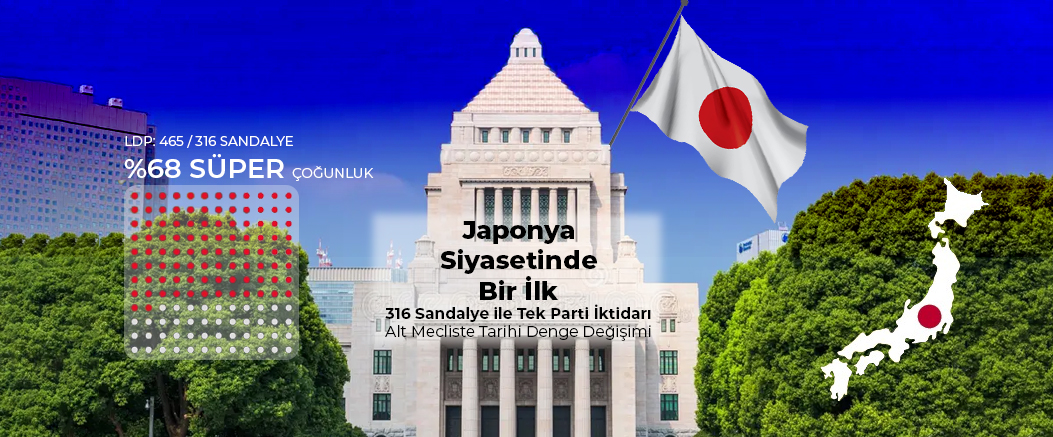
In Japan’s snap general election held on 8 February, the Liberal Democratic Party (LDP) led by Sanae Takaichi won 316 of the 465 seats in Japan’s House of Representatives, securing a supermajority and forming a single-party government. This marked the largest electoral victory in Japanese history.
According to the results, for the first time a single party won a majority large enough to amend the Constitution on its own. The LDP—generally Japan’s leading party over the past 70 years—delivered the most successful election in its history at a time when it had been losing public trust due to scandals. Increasing its number of seats by 125 compared to the previous term and reaching 316, the LDP’s pre-election coalition partner, the Japan Innovation Party (JIP), became the third-largest party with 36 seats. Thus, the governing bloc reached an overwhelming majority of 352 seats, while 8 opposition parties shared the remaining 113 seats.
The Process That Led Japan to a Snap Election
The background to the snap general election in Japan is rooted in a deep legitimacy crisis within the ruling LDP. The slush-fund scandal that surfaced in 2023 and implicated many senior figures in the party caused an unprecedented erosion of trust in Japanese politics. The revelation that more than 80 LDP lawmakers improperly reported political donation income between 2018 and 2022 led to the resignation of four cabinet members; in the subsequent 2024 House of Representatives and 2025 House of Councillors elections, a significant share of candidates involved in the scandal suffered heavy defeats at the ballot box. While opinion polls showed that more than 80% of voters directly attributed the LDP’s losses to this scandal, a sharp decline in donation revenues also increased internal and external pressure on the party. These developments triggered the process that led to then–Prime Minister Kishida Fumio’s resignation on 1 October 2024.
Amid this deepening political crisis, Kishida’s successor Shigeru Ishiba resigned on 21 October 2025. With Ishiba’s resignation on 7 September, the LDP leadership was effectively left vacant; in the party leadership election held on 5 October, Sanae Takaichi was elected as the LDP’s first female party leader. Assuming the premiership on 21 October, Takaichi became the first female prime minister in Japanese history.
However, this leadership change also brought to the surface structural tensions that had been accumulating within the governing coalition for a long time. Indeed, on 10 October, Komeito leader Tetsuo Saito decided to withdraw his party from the coalition it had maintained with the LDP for 26 years, effectively ending the existing government architecture.
Following this development, Takaichi formed a new coalition with the JIP to restore political stability and established her government on 21 October. Meanwhile, a new political alignment emerged between the former coalition partner Komeito and the main opposition Constitutional Democratic Party (CDP), under the name “Centrist Reform Alliance.” However, despite entering the election with strong ambitions, this alliance failed to deliver a performance that met public expectations.
The new government under Takaichi quickly realized that the LDP’s legitimacy problem in the public eye could not be overcome through a leadership change alone. In this context, despite her party’s difficult period, Prime Minister Takaichi adopted a “confidence renewal” strategy by taking political risks: she announced the decision to hold a snap election on 19 January and dissolved the House of Representatives on 23 January. This decision was interpreted as a concrete sign both of the search for a fresh start within the LDP and of an effort to rebuild eroded public trust through a democratic test. By contrast, the main opposition and the former coalition partner’s decision to contest the election together turned the snap election into not only a vote of confidence, but also a critical turning point in which new alliance-seeking within Japan’s political system was tested.
Takaichi’s Japan
After Prime Minister Sanae Takaichi came to power, the economic and political direction pursued has been based on a policy package that addresses sustainable fiscal discipline and strategic investment priorities together. While emphasizing sustainability in public finances, the Takaichi administration also defines as a core priority the uninterrupted financing of necessary investments in areas such as defense, infrastructure, and technology. In Japan—experiencing inflation for the first time in many years—financial markets will closely monitor how the balance will be managed between investment-led goals and the fight against inflation.
The unlimited parliamentary power secured under Takaichi’s leadership will also strengthen the government’s hand on defense spending—an issue that holds a top priority among Takaichi’s campaign promises and lies at the center of ongoing debates.
In foreign policy, the Takaichi government is expected to follow a line that prioritizes Japan’s influence in Asia and defines regional competition more explicitly. In this framework, it appears the country is entering a period in which strategic competition with China will intensify, while Japan–U.S. relations will further strengthen. Takaichi’s reportedly good relations with Donald Trump increase the likelihood of closer cooperation with Washington in security and defense. Accordingly, Japan’s foreign policy is gaining a more ambitious and geopolitically proactive orientation, aligned with rising defense spending and regional power projection.
POLITICAL STRUCTURE IN JAPAN
Form of Government: Constitutional monarchy and parliamentary democracy under the 1947 Constitution
Head of State (Symbolic): Emperor — constitutionally, the Emperor is solely the symbol of the State and of the unity of the people, and has no executive or legislative authority.
Executive: Exercised by the Prime Minister—designated by the party or coalition holding the majority in parliament—and the Cabinet under the Prime Minister’s leadership. The Prime Minister is elected by the legislature, and the cabinet is politically accountable to parliament.
Legislature: Japan’s National Diet (Kokkai) is bicameral.
- House of Representatives (Shūgi-in) is one of the two chambers and is among the highest organs of the state. Core powers—such as the budget, legislation, and the selection of the prime minister—are concentrated in the House of Representatives. Members are elected for 4 years. It has 465 members.
- House of Councillors (Sangi-in) has 248 members, who serve 6-year terms. Half of the members are renewed every 3 years. It cannot be dissolved.
Judiciary: Judicial power is vested in independent courts with the authority of constitutional review.
————————————-
Bibliography:
https://asia.nikkei.com/politics/japan-election
https://www.csis.org/analysis/japans-26-year-old-ruling-coalition-collapses
https://www.cfr.org/articles/political-realignment-and-the-2026-japanese-election-ii
https://www.nippon.com/en/in-depth/d01210/
Date prepared: 25.02.2025
Sadık Harun Köksal